Material Selection for Electric Vehicles: Understanding the Role of NORYL™ Resin
Electric vehicles are changing how engineers think about material selection. Components are expected to be lighter, safer, and capable of operating reliably under electrical, thermal, and environmental stress. A material chosen for a battery enclosure may not be suitable for a charging connector, while a housing used outdoors has very different requirements from one installed inside the vehicle.
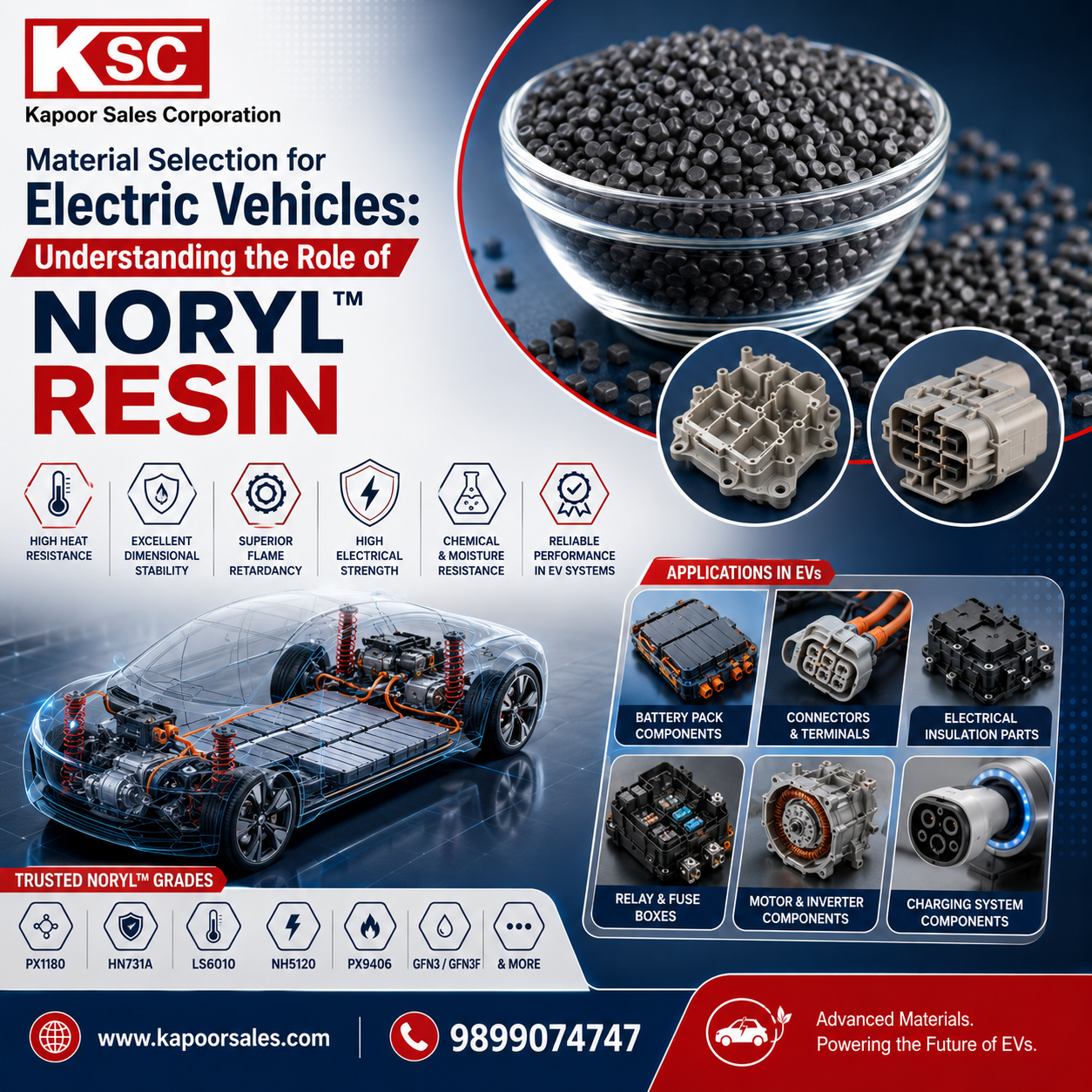
This is why NORYL resin for electric vehicles has become increasingly relevant. Instead of relying on a single formulation, engineers can choose from a broad portfolio of grades developed to meet the specific performance requirements of different EV systems.
What Makes EV Material Selection Different?
Every subsystem inside an electric vehicle has its own engineering priorities. Selecting a material means balancing several properties rather than focusing on just one.
Because these requirements often overlap, manufacturers evaluate materials based on overall performance instead of individual specifications.
How NORYL™ Resin Supports EV Applications
The range of NORYL resin grades allows engineers to match materials with the function of each component instead of using one grade throughout the vehicle.
For battery-related electrical housings and power distribution systems, flame-retardant grades such as PX9406, N850, and NH6020 help meet fire safety requirements while maintaining good electrical insulation.
Where structural rigidity is important, glass-reinforced grades including PX138H, GFN1720, and IGN320 provide improved stiffness and dimensional stability for components that must retain their shape under continuous mechanical and thermal loading.
Outdoor charging infrastructure introduces another set of challenges. Grades such as PX9406P, NH7010, and NH5120 are designed for applications requiring weather resistance alongside dependable electrical performance.
Choosing the Right Grade Starts with the Component
Many formulations are based on PPE + PS engineering plastic, giving manufacturers flexibility to select a grade that aligns with both design and manufacturing requirements.
Instead of asking which grade has the highest specification, engineers typically begin with a different question: What will this component experience throughout its service life? The answer determines whether flame retardancy, stiffness, outdoor durability, or moisture resistance becomes the deciding factor.
Factors That Influence Material Selection
Material selection extends well beyond the datasheet. Design teams typically evaluate several practical considerations before approving a resin for production.
- Electrical insulation for high-voltage systems
- Resistance to heat and thermal cycling
- Dimensional stability for precision assemblies
- Moisture and hydrolytic resistance
- Processability during injection molding
- Long-term durability in outdoor environments
Working with an experienced NORYL resin supplier can simplify this process by identifying grades that satisfy both engineering requirements and manufacturing objectives, reducing the need for unnecessary design iterations.
Final Thoughts
Electric vehicle development continues to push engineering materials beyond traditional automotive requirements. Flame retardancy, electrical insulation, dimensional stability, and lightweight construction now need to work together within increasingly compact designs.
Choosing the right material is therefore less about finding a single "best" resin and more about selecting the formulation that best matches the application. Partnering with an established engineering plastic supplier in India gives manufacturers access to a wider range of material options and technical guidance, helping them identify suitable NORYL™ resin grades for battery systems, charging infrastructure, electrical housings, and other critical EV components.